
Vietnam Manufacturing & Sourcing Insights
Market intelligence, manufacturing trends, product categories and supply chain developments for international buyers sourcing from Vietnam.
Last Updated: June 18, 2026
Macro Overview
Vietnam remains one of Asia’s most dynamic sourcing and manufacturing markets, supported by strong GDP growth, record trade activity, resilient foreign investment, and an expanding industrial park network.
8.02%
Vietnam recorded one of its strongest growth years in more than a decade.
$470.6B
Exports grew strongly, led by electronics, machinery, textiles, footwear, and consumer goods.
$27.6B
FDI disbursement reached a five-year high, with manufacturing the dominant recipient.
431+
Vietnam has a broad industrial park and export processing zone network supporting foreign manufacturers.
2025 Export Market Breakdown
Manufacturing & Investment Indicators
Share of implemented FDI going into manufacturing & processing.
Average monthly worker income reported for 2025.
Total goods trade turnover in 2025.
Estimated full-year trade surplus.
What This Means for Buyers
- Vietnam is no longer only a low-cost sourcing alternative; it is a major export manufacturing base.
- Manufacturing FDI remains strong, especially in electronics, industrial goods, textiles, and export-oriented production.
- Rising wages mean buyers should focus on total value, supplier capability, and process control — not labor cost alone.
- The US remains Vietnam’s most important export market, making tariff policy and origin compliance important.
Strategic Watch Points
- Vietnam benefits from China+1 strategies, but supplier capability varies significantly by sector and region.
- Trade policy, tariffs, and rules of origin can affect landed costs and sourcing decisions.
- Industrial zones are expanding, but location, logistics access, and workforce availability still matter.
- Factory verification and quality control remain essential for buyers entering Vietnam for the first time.
Why Buyers Source from Vietnam
Vietnam has become a leading sourcing destination for international buyers looking to diversify supply chains, access competitive manufacturing, and build export-ready supplier networks.
China+1 Diversification
Many buyers use Vietnam to reduce dependency on one manufacturing country and create a more resilient sourcing base in Asia.
Competitive Labor
Vietnam remains cost-competitive in many labor-intensive industries while continuing to develop stronger industrial skills.
Trade Agreements
Agreements such as EVFTA, CPTPP, and RCEP support Vietnam’s access to major global export markets.
Export Manufacturing Maturity
Vietnam has developed strong production ecosystems in electronics, furniture, textiles, footwear, packaging, and consumer goods.
Strategic Location
Vietnam’s position near China, ASEAN, and major sea routes supports regional sourcing flexibility and efficient export logistics.
Electronics Growth
Large-scale electronics investment has strengthened industrial parks, supplier networks, and technical manufacturing capabilities.
Vietnam Manufacturing Advantages for Buyers
| Advantage | Why It Matters | Buyer Impact |
|---|---|---|
| Supply Chain Diversification | Reduces overreliance on a single sourcing country | Improves resilience and sourcing flexibility |
| Export Orientation | Factories are increasingly experienced with international buyers | Better documentation, packaging, and export readiness |
| Trade Integration | Vietnam is connected to major regional and global trade agreements | Potential tariff and market-access advantages |
| Industrial Growth | FDI continues to expand manufacturing capacity | Broader supplier base and stronger production ecosystems |
Best-Fit Product Categories
- Furniture and homeware
- Textiles, garments, and footwear
- Electronics and components
- Packaging and plastics
- Consumer goods
- Industrial parts and metal products
Buyer Considerations
- Supplier capability varies by sector and region
- Factory verification remains essential
- Quality control should be planned before production
- Rising wages make productivity and process control important
- Vietnam complements China rather than replacing it in every category
Key Industries & Products Sourced from Vietnam
Vietnam offers sourcing opportunities across export-oriented manufacturing, industrial, agricultural, and consumer product sectors.
Wood, Metal & Home Furniture
Strong export base for indoor, outdoor, upholstered, and home furniture.
- Wood, rattan, metal
- FSC compliance
- Export-ready suppliers
Garments, Fabrics & Footwear
Large apparel and footwear production base supported by skilled labor.
- Garments
- Footwear
- Fabric sourcing
Components & Assembly
FDI-driven electronics growth supported by major global manufacturers.
- Assembly
- Components
- Testing required
Paper, Flexible & Retail Packaging
Growing capacity in cartons, labels, retail packaging, and flexible packaging.
- Cartons
- Flexible packaging
- Artwork accuracy
OEM & Private Label Products
Suitable for customized consumer products, home goods, and lifestyle items.
- OEM production
- Private label
- Sampling important
Machining, Metalwork & Components
Developing capability in machining, fabrication, plastics, and components.
- CNC machining
- Metal fabrication
- Technical drawings
Seafood, Coffee & Agricultural Exports
Vietnam is a major exporter of seafood, coffee, rice, pepper, and cashews.
- Shrimp, pangasius
- Coffee, rice, cashews
- Food safety compliance
Rubber Goods & Molded Products
Opportunities in molded parts, rubber products, plastic components, and tooling.
- Injection molding
- Rubber products
- Material consistency
Ceramics, Stone & Construction Materials
Vietnam offers ceramics, tiles, stone products, and selected construction materials.
- Tiles
- Natural stone
- Packaging protection
Industry Comparison for Buyers
| Industry | Strength | Buyer Watch Point |
|---|---|---|
| Furniture | Export maturity | Wood certification |
| Textiles & Footwear | Labor competitiveness | MOQ and compliance |
| Electronics | FDI ecosystem | Testing and certification |
| Packaging | Growing print capacity | Artwork accuracy |
| Consumer Goods | OEM potential | Sample validation |
| Industrial Products | Machining and components | Tolerances and inspection |
| Agriculture & Aquaculture | Strong export base | Food safety and traceability |
| Rubber & Plastics | Molded products | Tooling quality |
| Building Materials | Ceramics and stone | Breakage and grading |
Vietnam Labor Costs & Workforce
Vietnam’s manufacturing workforce remains one of the country’s major sourcing advantages. International buyers evaluate Vietnam not only for labor cost competitiveness, but also for workforce availability, industrial specialization, productivity trends, and long-term manufacturing development.
~8–10M VND
Wage levels vary significantly depending on region, industry, skill level, and factory type.
North & South
Major industrial labor pools are concentrated around HCMC, Binh Duong, Dong Nai, Bac Ninh, and Hai Phong.
Millions Employed
Manufacturing remains one of Vietnam’s largest employment sectors supporting export-oriented production.
Gradual Increase
Vietnam’s labor costs continue to rise gradually as industrialization and worker demand expand.
Regional Manufacturing Wage Differences
| Region | Typical Characteristics | Buyer Considerations |
|---|---|---|
| Ho Chi Minh City Region | Mature supplier ecosystem, strong export manufacturing base, broad labor availability. | Higher wage pressure and stronger competition for experienced workers. |
| Binh Duong & Dong Nai | Major industrial manufacturing zones with strong furniture, packaging, and industrial production. | Competitive industrial capabilities but increasing labor competition. |
| Northern Vietnam | Electronics and industrial manufacturing growth around Bac Ninh, Hai Phong, and Hanoi. | Strong electronics ecosystem and export manufacturing development. |
| Central Vietnam | Developing industrial regions with growing manufacturing investment. | Lower industrial density but potential future growth opportunities. |
Minimum Wage Trends
Vietnam’s minimum wages are adjusted periodically and vary by region. Industrialized urban regions generally maintain higher wage levels than less developed provinces.
- Regional wage classification system
- Gradual long-term wage increases
- Industrial zones influence wage pressure
- Export manufacturing drives labor demand
Labor Availability
Vietnam maintains a large industrial workforce, although labor availability varies significantly by region, seasonality, and manufacturing sector.
- Strong labor pools in industrial regions
- Higher competition during peak production periods
- Worker retention increasingly important
- Migration supports industrial manufacturing growth
Skilled Labor Challenges
As manufacturing becomes more technical, some industries face shortages in engineering, tooling, automation, and specialized production skills.
- Technical workforce development continues
- Electronics and industrial sectors most affected
- Management capability varies by factory
- Training investment increasingly important
Productivity Evolution
Vietnam’s manufacturing productivity has improved steadily through foreign investment, industrial upgrading, automation, and export manufacturing experience.
- Industrial capability continues to mature
- Export-focused factories improving systems
- Automation adoption gradually increasing
- Operational management remains critical
Industries Most Dependent on Labor Cost Competitiveness
- Garments and textiles
- Footwear manufacturing
- Furniture assembly
- Packaging production
- Consumer goods assembly
- Agricultural processing
Strategic Buyer Considerations
- Low labor cost alone does not guarantee sourcing success
- Supplier systems and management capability remain essential
- Industrial workforce quality varies significantly
- Long-term sourcing requires stable supplier relationships
- Productivity and process control increasingly matter
Vietnam vs China Manufacturing
Vietnam and China both play important roles in global manufacturing supply chains. Rather than viewing one country as universally “better,” experienced buyers evaluate each sourcing market based on product category, supply chain requirements, production complexity, quality expectations, and long-term sourcing strategy.
| Category | Vietnam | China |
|---|---|---|
| Labor Costs | Generally more competitive in labor-intensive manufacturing sectors such as furniture, garments, packaging, and selected consumer products. | Labor costs are typically higher in many coastal manufacturing regions but productivity and automation levels are often stronger. |
| Lead Times | Lead times can be competitive, although supplier capacity and material sourcing dependencies may affect production schedules. | China often benefits from highly integrated supplier ecosystems and faster material availability across many industries. |
| Supply Chain Depth | Vietnam’s supplier ecosystem continues to expand, though some industries still depend on imported materials or upstream components. | China maintains one of the world’s deepest manufacturing ecosystems with strong upstream and downstream supplier integration. |
| Minimum Order Quantities (MOQ) | MOQs can sometimes be more flexible depending on factory size and product category, particularly for developing supplier relationships. | China offers broad supplier diversity, though MOQs vary significantly depending on factory scale and production specialization. |
| Tooling & Engineering | Vietnam continues to develop technical manufacturing and tooling capabilities, especially in industrial and electronics sectors. | China generally maintains stronger tooling ecosystems, engineering support, and specialized technical manufacturing infrastructure. |
| Quality Consistency | Quality capability varies significantly between suppliers. Factory verification, sampling, and QC remain important. | China offers extensive manufacturing experience, though quality still depends heavily on supplier management and specifications. |
| Export Flexibility | Vietnam benefits from multiple trade agreements and strong export orientation toward US, EU, and ASEAN markets. | China remains highly export-capable with mature logistics infrastructure and broad international shipping connectivity. |
| Manufacturing Scale | Vietnam is highly competitive in selected sectors but overall manufacturing scale remains smaller than China’s. | China continues to dominate global manufacturing scale across a broad range of industries and technical categories. |
| Best-Fit Industries | Furniture, packaging, garments, footwear, selected electronics, OEM consumer goods, agricultural exports. | Advanced electronics, machinery, tooling-intensive manufacturing, chemicals, complex industrial supply chains. |
Where Vietnam Performs Strongly
- Export-oriented manufacturing
- Labor-intensive product categories
- China+1 diversification strategies
- Furniture and packaging production
- Selected OEM consumer products
- Trade agreement market access
Where China Maintains Advantages
- Supplier ecosystem depth
- Integrated manufacturing clusters
- Advanced tooling and engineering
- High-volume production capability
- Material sourcing availability
- Complex industrial manufacturing
What Experienced Buyers Typically Do
Many international buyers no longer view sourcing decisions as Vietnam versus China. Instead, they build diversified sourcing strategies across multiple manufacturing markets depending on product complexity, risk exposure, cost structure, and long-term operational requirements.
Vietnam is often used to complement existing China supply chains rather than replace them entirely.
Strategic Takeaway
Vietnam continues to strengthen its position as a global sourcing and manufacturing hub, particularly in export-oriented sectors. However, China remains highly competitive due to its industrial scale, engineering depth, and integrated supply chain infrastructure.
The most effective sourcing strategies are usually category-specific, data-driven, and supported by proper supplier qualification and operational oversight.
Vietnam’s Export Growth
Vietnam has positioned itself as one of Asia’s leading export manufacturing hubs, supported by strong foreign investment, expanding industrial capacity, and deep integration into global supply chains.
$475B
Vietnam’s export value reached a record high in 2025.
+17%
Exports expanded strongly year on year.
$930B
Total import-export turnover reached a new record.
$20B+
Vietnam maintained a sizeable goods trade surplus.
2025 Export Market Breakdown
Why Vietnam Is Becoming an Export Champion
- Strong export-oriented manufacturing base
- High levels of foreign direct investment
- Competitive position in China+1 strategies
- Major trade agreements including EVFTA, CPTPP, and RCEP
- Growing logistics and industrial park infrastructure
What This Means for Buyers
- More mature export documentation and shipping processes
- Broader supplier options in key product categories
- Increasing competition for strong factories
- Greater need for origin compliance and supplier verification
- Better long-term potential for diversified sourcing strategies
Export Growth: Buyer Interpretation
| Indicator | 2025 Signal | Buyer Relevance |
|---|---|---|
| Total Exports | Record export value of about $475B | Shows strong global demand for Vietnam-made goods |
| US Market | Exports to the US reached about $153B | Confirms Vietnam’s importance for US-focused sourcing |
| FDI | Disbursed FDI reached about $27.6B | Supports continued manufacturing capacity expansion |
| Industrial Production | Industrial production rose around 9.2% | Signals continued factory output growth |
Tariffs, Trade Agreements & Geopolitics
Vietnam’s role in global manufacturing has expanded significantly as international buyers diversify supply chains, respond to geopolitical risks, and evaluate tariff exposure across multiple sourcing markets.
15+
Vietnam participates in multiple regional and international trade agreements supporting export market access.
Global Supply Chains
Vietnam’s manufacturing economy remains strongly connected to US, EU, ASEAN, and Asian trade flows.
Long-Term Shift
Many buyers use Vietnam as part of broader supply chain diversification strategies.
Increasingly Important
Customs enforcement, origin verification, and trade compliance continue to receive greater attention globally.
US–China Trade War Impact
Trade tensions between the United States and China accelerated global supply chain diversification across multiple manufacturing industries.
- Buyers increasingly diversify sourcing exposure
- Vietnam benefited from manufacturing relocation trends
- Export manufacturing investment expanded significantly
- Tariff exposure became a strategic sourcing factor
China+1 Manufacturing Strategies
Many international companies now operate “China+1” sourcing models where Vietnam complements existing China supply chains.
- Risk diversification across sourcing markets
- Reduced dependency on single-country production
- Improved supply chain resilience
- Category-specific sourcing optimization
CPTPP Trade Agreement
The Comprehensive and Progressive Agreement for Trans-Pacific Partnership (CPTPP) supports Vietnam’s integration into regional trade networks.
- Expanded market access opportunities
- Reduced trade barriers in participating countries
- Strengthened export competitiveness
- Long-term regional trade integration
EVFTA & European Market Access
The EU–Vietnam Free Trade Agreement (EVFTA) strengthened Vietnam’s export relationship with European markets.
- Tariff reduction opportunities
- Higher compliance expectations
- Greater focus on traceability and documentation
- Strong relevance for furniture and textiles
RCEP & Regional Integration
RCEP supports broader Asian regional integration and strengthens supply chain connectivity across participating economies.
- Regional sourcing integration
- Cross-border manufacturing ecosystems
- Material sourcing flexibility
- Long-term ASEAN supply chain development
Tariff Diversification
Buyers increasingly evaluate tariff exposure across sourcing countries as part of long-term procurement and pricing strategies.
- Reduced concentration risk
- Flexible sourcing structures
- Geopolitical risk management
- Market-specific sourcing decisions
Trade & Compliance Considerations for Buyers
| Topic | Strategic Importance | Buyer Consideration |
|---|---|---|
| Country of Origin | Determines tariff treatment and customs classification. | Proper documentation and production transparency are essential. |
| Anti-Dumping Risks | Certain industries may face trade investigations or additional duties. | Buyers should monitor sector-specific regulatory developments. |
| Origin Compliance | Customs authorities increasingly verify manufacturing origin claims. | Supply chain traceability and factory transparency matter. |
| Trade Agreements | Can support tariff advantages and export competitiveness. | Benefits depend on product category and compliance qualification. |
| Geopolitical Exposure | Global trade tensions influence sourcing decisions and logistics flows. | Diversification strategies increasingly common among buyers. |
Industries Most Influenced by Trade Agreements
- Furniture and home products
- Textiles and footwear
- Electronics and components
- Packaging and consumer goods
- Industrial manufacturing exports
- Agricultural and seafood exports
Strategic Buyer Considerations
- Trade agreements do not automatically eliminate all tariff exposure
- Origin compliance requirements are increasingly important
- Supply chain transparency matters more than ever
- Country diversification strategies continue to expand globally
- Regulatory developments should be monitored continuously
Vietnam Supply Chain Developments
Vietnam’s supply chain is evolving from a low-cost production base into a more mature regional manufacturing hub. Growth in industrial parks, logistics infrastructure, foreign investment, and supplier ecosystems is creating new opportunities for international buyers.
Supply Chain Diversification
Vietnam continues to benefit from buyers reducing overreliance on single-country sourcing models.
Industrial Park Expansion
New and expanding industrial zones are supporting export manufacturing across northern and southern Vietnam.
Port & Freight Development
Vietnam’s export growth is increasing demand for better port access, warehousing, and freight coordination.
Growing Local Ecosystems
Supplier networks are improving in furniture, electronics, packaging, textiles, plastics, and industrial components.
Manufacturing Upgrading
Factories are gradually investing in automation, quality systems, and improved production management.
More Compliance Pressure
Rules of origin, traceability, and export documentation are becoming increasingly important for buyers.
Supply Chain Developments & Buyer Impact
| Development | What Is Changing | Buyer Impact |
|---|---|---|
| Industrial Zones | More manufacturing capacity outside traditional hubs | Broader supplier options by region |
| Export Logistics | Higher demand for ports, warehouses, and freight services | Earlier logistics planning becomes more important |
| Supplier Ecosystems | Local supplier networks are gradually deepening | More sourcing options, but capability still varies |
| Compliance | More attention on origin, documentation, and traceability | Factory transparency becomes critical |
Opportunities for Buyers
- More diversified sourcing options
- Growing export manufacturing capability
- Expanding industrial park infrastructure
- Improved supplier specialization in key sectors
- Better long-term China+1 positioning
Challenges to Manage
- Supplier capability varies by region and product type
- Some materials still depend on imported inputs
- Port congestion can affect peak-season shipments
- Quality systems are not consistent across factories
- Origin compliance must be carefully documented
Key Industrial Zones & Manufacturing Regions
Manufacturing capabilities in Vietnam are concentrated around several industrial clusters, each with distinct strengths, supplier ecosystems, labor pools, logistics infrastructure, and export specializations. Understanding regional differences can help buyers identify the most suitable sourcing locations for their products.
Ho Chi Minh City & Binh Duong
Mixed manufacturing, furniture, packaging, consumer products, plastics, industrial production, and export trading.
Dong Nai
Large-scale industrial manufacturing, machinery, components, industrial parks, and export production.
Bac Ninh
Electronics manufacturing, supplier ecosystems, assembly operations, and high-value export production.
Hai Phong
Export logistics, deep-water port access, industrial manufacturing, and international shipping connectivity.
Da Nang
Emerging manufacturing center with growing industrial investment and improving logistics infrastructure.
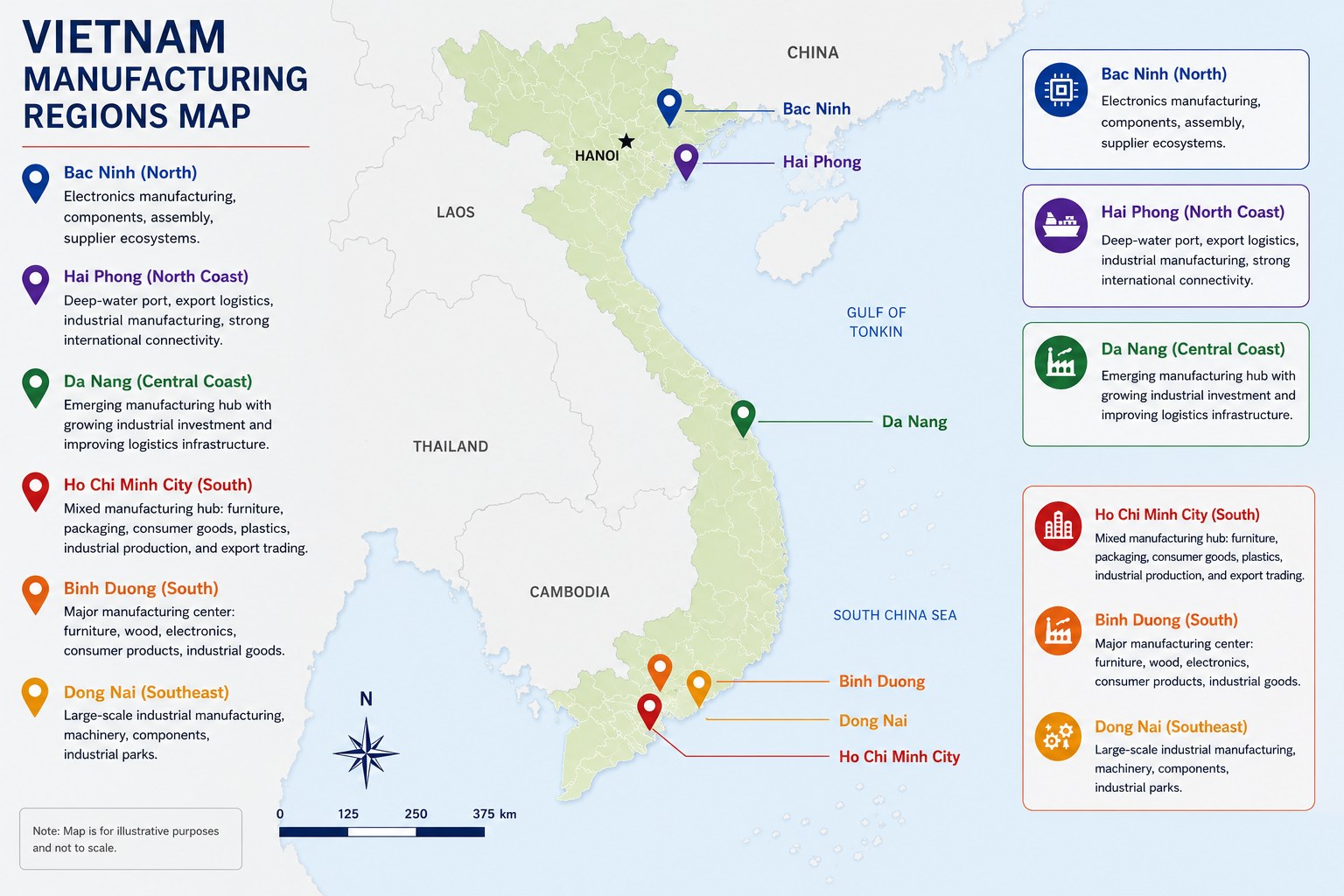
Regional Manufacturing Comparison
| Region | Primary Strengths | Typical Industries | Buyer Considerations |
|---|---|---|---|
| Ho Chi Minh City / Binh Duong | Large supplier ecosystem, export experience | Furniture, packaging, consumer goods, plastics | Strong capabilities but higher labor competition |
| Dong Nai | Industrial manufacturing capacity | Industrial products, machinery, components | Strong industrial park infrastructure |
| Bac Ninh | Electronics ecosystem | Electronics, components, assembly | Strong FDI-driven supplier network |
| Hai Phong | Export logistics and port access | Industrial manufacturing, export production | Excellent international shipping connectivity |
| Da Nang | Emerging manufacturing base | Mixed manufacturing and industrial production | Growing but smaller supplier ecosystem |
Best Regions for Export Manufacturing
- Southern Vietnam remains the largest manufacturing region
- Northern Vietnam dominates electronics and component production
- Hai Phong offers excellent export logistics connectivity
- Binh Duong remains a major furniture and industrial hub
- Industrial park development continues nationwide
Strategic Buyer Considerations
- Supplier capability often matters more than province location
- Logistics costs vary significantly by region
- Labor availability differs between industrial clusters
- Regional specialization can improve sourcing efficiency
- Factory verification remains essential regardless of location
Risks & Challenges of Sourcing from Vietnam
Vietnam offers significant sourcing opportunities, but buyers should approach the market with realistic expectations. Like any manufacturing destination, Vietnam presents operational, commercial, and supply chain risks that require proper planning and supplier management.
Infrastructure Constraints
While logistics infrastructure continues to improve, road congestion, port bottlenecks, and peak-season shipping delays can still affect lead times.
Supplier Fragmentation
Vietnam's supplier landscape is highly fragmented. Capability, capacity, quality systems, and export experience can vary significantly between factories.
Quality Inconsistency
Strong factories can deliver excellent quality, but consistency often depends on specifications, process control, and production supervision.
Language Barriers
English proficiency varies across management teams, engineers, and production staff. Technical communication should always be documented clearly.
Trading Companies & Middlemen
Many suppliers present themselves as manufacturers while acting as traders. Factory verification is often necessary to confirm actual production capabilities.
Compliance Variation
Certification levels, social compliance practices, environmental standards, and documentation quality vary considerably between factories.
Common Buyer Challenges & Mitigation Strategies
| Challenge | Potential Impact | Recommended Approach |
|---|---|---|
| Unverified Suppliers | Production capability mismatch | Conduct supplier due diligence and factory audits |
| Quality Variability | Defects and customer complaints | Implement inspections and approval procedures |
| Communication Gaps | Specification misunderstandings | Use detailed RFQs and written confirmations |
| Supply Chain Delays | Missed delivery schedules | Build buffer time into production planning |
| Compliance Gaps | Import and customer risks | Verify certifications and documentation directly |
| Overdependence on One Supplier | Business continuity risk | Diversify sourcing where practical |
Structural Challenges Facing Vietnam
- Continued dependence on imported raw materials in some sectors
- Increasing labor competition in major industrial hubs
- Capacity constraints during periods of rapid export growth
- Pressure to meet rising compliance expectations from global buyers
- Exposure to global demand fluctuations and trade policy changes
Why Buyers Still Choose Vietnam
- Strong export manufacturing ecosystem
- Competitive labor costs compared with many alternatives
- Extensive trade agreement network
- Growing industrial capabilities across multiple sectors
- Strategic role in global supply chain diversification
The Future of Manufacturing in Vietnam
Vietnam's manufacturing sector is entering a new phase of development. While cost competitiveness remains important, future growth is increasingly being driven by automation, technology adoption, sustainability requirements, industrial upgrading, and participation in higher-value global supply chains.
Factory Automation
Many export-oriented manufacturers are gradually investing in automation to improve productivity, reduce labor dependency, and enhance quality consistency.
Higher-Value Manufacturing
Vietnam is seeking to attract more advanced manufacturing activities, including electronics, precision engineering, industrial components, and technology-intensive production.
AI & Smart Factories
Larger manufacturers are beginning to implement digital production monitoring, predictive maintenance, data analytics, and smart factory technologies.
Growing ESG Expectations
International buyers increasingly require environmental compliance, carbon reporting, responsible sourcing, and stronger social governance standards.
Rising Wage Pressure
Manufacturing wages continue to increase as industrialization advances, encouraging productivity improvements and greater process efficiency.
Continued Relocation Trends
Many multinational companies continue to diversify production footprints, reinforcing Vietnam's role within broader regional sourcing strategies.
Key Manufacturing Trends to Watch
| Trend | What Is Happening | Potential Buyer Impact |
|---|---|---|
| Automation | Increasing investment in automated production systems | Potential quality improvements and greater production consistency |
| Wage Growth | Steady increases in manufacturing labor costs | Reduced focus on labor arbitrage alone |
| ESG Requirements | Stronger sustainability and compliance expectations | More supplier audits and documentation requirements |
| AI & Digitalization | Adoption of data-driven production management | Improved visibility and operational efficiency |
| Industrial Upgrading | Shift toward higher-value manufacturing sectors | More advanced sourcing opportunities |
| Supply Chain Diversification | Ongoing China+1 and regional sourcing strategies | Continued investment and capacity growth |
Opportunities for Buyers
- Access to increasingly sophisticated manufacturing capabilities
- Growing supplier investment in technology and quality systems
- More diversified sourcing ecosystems across industries
- Improved export infrastructure and logistics networks
- Stronger integration into global supply chains
Challenges to Monitor
- Rising labor costs over the long term
- Competition for skilled technical talent
- Increasing ESG and compliance requirements
- Potential geopolitical and trade policy shifts
- Need for continuous supplier capability assessment